从句时态:
- 主将从现
i will hit u when you come here
if it rains, i will hit u.
- 主过从过
复合句有先后关系,过去+过去完成时, eg. when he came there, the train had gone.
- 主现从任
he tells me that u have died
语法-词法笔记
全的笔记: https://www.yuque.com/littlematch/english/nbd4rd
下面仅列我需要关注的。
代词
物主代词
| 他的 his/his | 她的 her/hers | 它的 it/its | 他们的 their/theirs |
The book is hers
their 除了表示他们的,还可以用来表示单数,像 他 或者 她。不想指明性别时,就可以用 their 来替代 his、her
Each passenger must show their ID. 每个乘客都必须展示他们的身份证 Everyone should write their name on the form. 每个人应该在表格上写他们的名字 Someone left their bag on the table! 有人把他们的包留在了桌子上
关系代词
This is the chair whose leg is broken. 这就是那个折了腿的椅子。 whose可以指物。用which’s 是不标准的。
疑问代词
who、whom、what、which 还可以与 ever 构成复合疑问代词(没有 whoseever),用于加强语句
- I hate whoever lies. 我痛恨任何一个说谎的人
- I trust whomever you trust. 你信任的人我都信任
- Whatever you say, facts are facts. 不管你说什么,事实总是事实
- You may choose whichever you like. 你喜欢哪一个就选哪一个
指示代词
单算数都行
such 这样的: Such is her way./Such are the results (名词性)
She is such a kind friend./Such birds fly away. (形容词性)
so 如此:
So does everyone./So do some birds. (只有名词性)
this(these)指下文中将要提到的事物,that(those)指上文中提到的事物
- This is what he said: Don’t go out! 这就是他说的,不要出去
- I was ill, that’s why I missed the meeting. 我病了,这就是为什么我没参加会议的原因
冠词
零冠词
1、泛指的复数名词前,一般不加冠词
They are singers. 他们是歌手
2、表示一般事物时,通常不加冠词;表示特定意思时,需要加定冠词 the
Birds can fly. 鸟能飞 The birds want food. 那些鸟想要食物 Pigs can’t fly. 猪不能飞 The pigs are eating. 那些猪在吃饭
3、在季节、月份、节日、假日、日期、星期等表示时间的名词之前,不加冠词
We work from Monday to Friday. 我们从星期一工作到星期五
4、表示人名、称呼、官衔、职位等名词前不加冠词
| Mary 玛丽 | General Lee 李将军 |
5、在三餐、球类运动和娱乐运动的名称前,不加冠词
have breakfast 吃早餐 have lunch 吃午餐 play chess 下象棋 play basketball 打篮球
6、by 与交通工具连用时,中间无冠词
| by bus | by air | by bike | by train | by car |
7、有些个体名词不用冠词,直接置于介词后,表示该名词的内涵意义
此类个体名词有:hospital 医院、prison 监狱、school 学校、college 大学、market 市场、bed 床、table 桌子、class 班级、town 城镇、church 教堂、court 法院等
go to school 去上学 go to the school 去学校(不一定是上学,可能是有别的事) go to church 去教堂做礼拜 go to the church 去教堂(不一定是做礼拜,可能是有别的事) go to hospital 去医院看病 go to the hospital 去医院(不一定是看病,可能是有别的事) at school 在上学 at the school 在学校里 in class 在上课 in the class 在班级里 at work 在工作 at the work 在工作中 at desk 在读书 at the desk 在课桌旁 at table 在进餐 at the table 在桌子旁 in hospital 住院 in the hospital 在医院里
“限制性定语从句”和“非限制性定语从句”的区别
She despised people who flattered her. 这是限制性的。非限制性就是表定语 非限制的 (她看不起那些吹捧她的人。)
在上面的示例中,定语从句“who flattered her”起到了限制名词的作用(即缩小了名词的表示范围)。
因此,我们称这类定语从句为限制性定语从句。
在有些场景下,先行词的指向已经是唯一的了,此时就无法再缩小这个词的表示范围了。例如:
I made a card for mom who loves me most**. (×) (我给最爱我的**那个妈妈做了一张卡片。)
每个人只有一个妈妈,所以“最爱我的那个妈妈”的表述明显不合逻辑,此时我们就需要用到非限制性定语从句。
所谓的非限制性定语从句,就是使用“逗号”将定语从句与先行词隔开,即:
I made a card for mom, who loves me most**. (我给妈妈做了一张卡片,她最爱我**。)
因为非限制性定语从句的作用是:不直接修饰先行词,只为先行词提供一些补充的信息。
①限定性定语从句: 从句不能省略,如果省略整个句子意思不完整。
非限定性定语从句: 从句可以省略,如果省略整个句子意思仍然完整 。
②限定性定语从句: 先行词可以用that 引导。
非限定性定语从句: 先行词不可以用that 引导。
eg. I like read the book that you lend me.
③限定性定语从句: 引导词有时可以省略。
非限定性定语从句: 引导词不可以省略。
④限定性定语从句: 主句与从句不需要用逗号隔开。
非限定性定语从句: 主句与从句需要用逗号隔开。
⑤限定性定语从句: 从句只修饰先行词。
非限定性定语从句:从句既可以修饰先行词,也可以修饰整个句子或句子的一部分。
逗号使用
1、当有三个或三个以上并列的单词或短语时,这些单词或短语要用逗号隔开,而且最后一个单词或短语一般都会用and或or连接,如:
We had coffee, cheese and crackers and grapes.
2、当两个前置形容词并列且可以调换顺序时,要用逗号隔开,如:
He is a strong, healthy man. vs. He is a healthy, strong man.
1、如果是以从句开头,则要在从句末尾用逗号隔开,如:
If you are not sure about this, let me know now.
2、如果开头的是介绍性短语,一般也要用逗号隔开,如:
Having finally arrived in town, we went shopping.
3、如果介绍性短语是以介词开头引导的,介词后面如果跟的是句子的主语,则要用逗号。则无论这个短语包含多少个单词,都无需用逗号隔开,如:
Between your house on Main Street and my house on Grand Avenue, the mayor’s mansion stands proudly.
1、同位语,如:
My best friend, Joe, arrived.
2、非限定性定语从句(非限制作用,也不能用that),如:
Jill, who is my sister, shut the door.
3、分词短语,如:
The man, knowing it was late, hurried home.
语法-可数及不可数名词和主谓一致
可数及不可数名词
参考: https://www.hellotoabc.com/-53.html
另一个笔记: https://www.yuque.com/littlematch/english/cw7hym#AS8Ub
1)可数名词:可以一个一个数的,所以是可数。 不可数名词是不可以一个一个数的,所以不可数。
2)既然不可数名词都不能一个一个数,当然没有复数形式,当然也不能用a/an(表示“一”的含义)或是数词来修饰。因为复数、a、an和数词都是与数目相关的。
英语中的不可数名词常包括:
1) 液体类:juice 果汁, water水, tea茶,milk牛奶
2) 肉类:beef牛肉,pork猪肉, meat肉, chicken鸡肉
3) 粉末类/微粒类:salt盐,sugar糖,rice米,sand沙
4) 抽象名词类:news新闻、消息,time时间,love爱情等
5) 食物类: rice大米,food食物,bread面包,cheese奶酪
6) 语言类:Chinese中文,English英语,French法语
7)物质类:wood 木头,iron铁
8)专有名词:the West Lake 西湖
以下名词是不可数名词,易被误认是可数
paper纸,cake蛋糕,bread面包,advice建议,furniture家具
hair头发,homework作业,knowledge知识,money钱,news新闻,information信息
可数名词有哪些常用修饰语
通常用于修饰可数名词的修饰语有some, any, many, few, a few, a lot of, lots of, plenty of大量的, a great many, a great number of等修饰。
注:其中的some, any, a lot of, lots of, plenty of既可用于修饰可数名词,也可用于修饰不可数名词;而其中的many, few, a few, a great many, a great number of则只用于修饰可数名词,不用于修饰不可数名词。
a few = some/ a small number of. few = not very many. a few > few.
不可数名词有哪些常用修饰语
通常用于修饰不可数名词的修饰语有some, any, much, little, a little, a lot of, lots of, plenty of, a great deal of, an amount of, a quantity of 等修饰。
可以借助单位词来计算不可数名词的数量,有以下三种用法:
1、piece、bit、article、slice、slice 等表示“片、块、件、点”等
a piece of paper 一张纸 a bit of advice 一点忠告 a slice of bacon 一片腊肉 an article of furniture 一件家具
2、bar、block、cake、drip、flight、lump、loaf、grain、strip等表形状
a bar of gold 一根金条 a block of ice 一块冰 a cake of soap 一块肥皂 a drop of blood 一滴血
3、bag、basin、basket、bottle、box、cup、glass、can、bowl、jar、mug、pot、spoon、tin等表容器
a cup of coffee 一杯咖啡 a basin of water 一盆水 a bowl of rice 一碗饭 a bag of food 一包食物
piece有片、块的含义,a piece of cake也可以。
主谓一致
谓语动词的复数形式一般使用动词的原形来表示。
单数:is, likes, wants, has, doesn’t
复数: are, like, want, have, don’t
一般情况下,主谓之间的一致关系由以下三个原则的支配: 语法一致原则;意义一致原则;就近原则。
句子的谓语动词与主语的中心词保持一致,不受主语修饰语的影响。
内容一致,即看主语的内容(意义),而不只是看主语的形式。意义一致就是谓语动词的数必须和主语的意义一致(因有时主语形式为单数,但意义为复数;有时形式为复数,但意义为单数)。
谓语动词和离他最近的主语保持一致,就是我们常说的就近原则

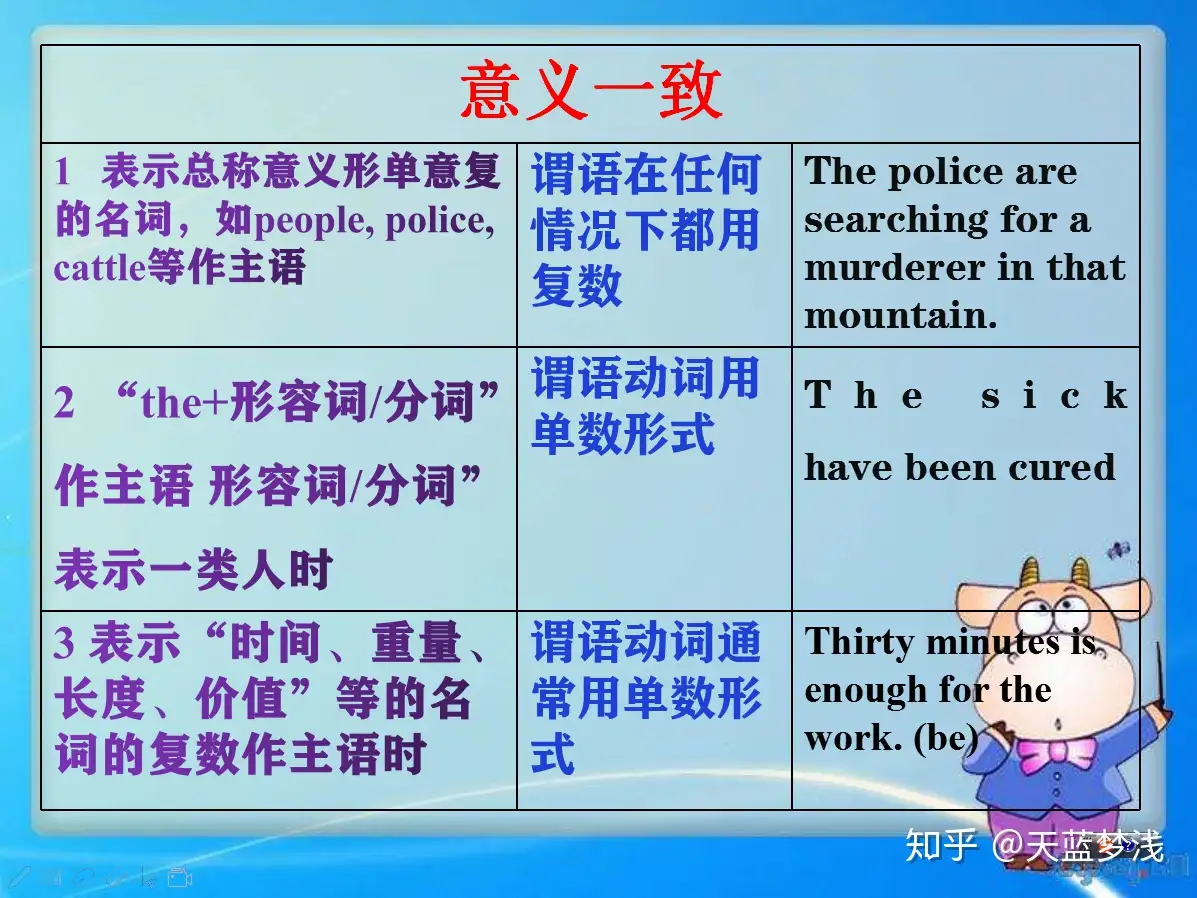
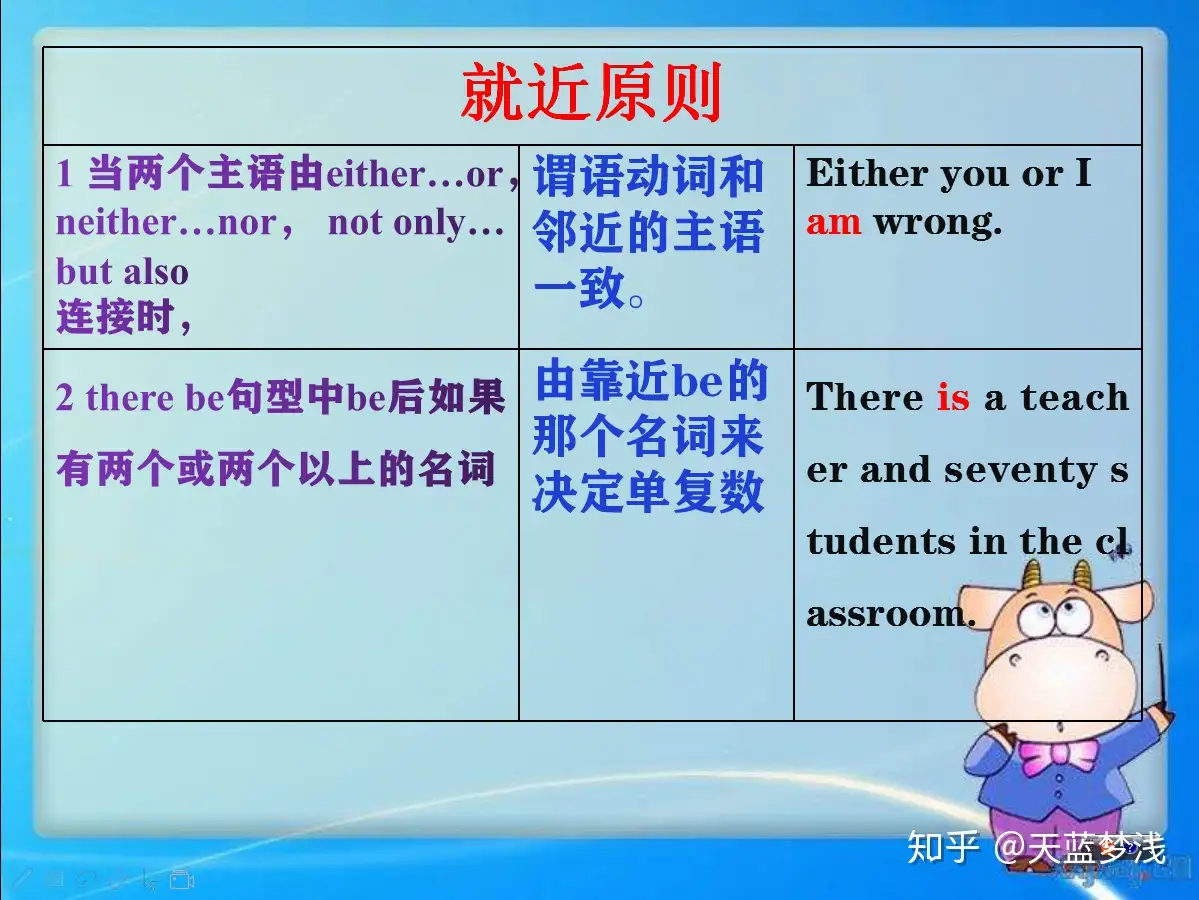
1)由“some of,plenty of,a lot of,lots of,most of,the rest of,all of,half of,part of,the remainder of或分数、百分数+of+名词”等短语作主语时,谓语动词常与of后的名词保持数的一致。
Half of the apple is rotten.这个苹果的一半腐烂变质了。
Half of the apples are rotten.这些苹果有一半腐烂变质了。
About one third of the books are worth reading.大约三分之一的书值得一读。
Over 30% of the students were absent from the meeting.
2)由“a kind of,this kind of,many kinds of”和“名词+of this kind”等,以及由与kind意义相似的type,sort,form,part,piece,section等构成的类似短语作主语时,谓语动词与of前的名词保持数的一致。如:
A kind of birds has been discovered by them.
Parts of the book are very instructive.
This kind of apples is expensive.
Apples of this kind are expensive.
3)“more+复数名词+than one”结构谓语常用复数。
More members than one have protested against the plan.
4)不定代词“each,one,no one,some(any,no,every)+body(one或thing)”在句中作主语或作限定词时,谓语动词一律用单数形式
Each boy gets a prize.
Someone wants to buy the house.
Each of the books costs five Yuan.
注意:each,all,both用作同位语时,谓语动词仍应与主语保持一致
We each have an English-Chinese dictionary.
由and连接的两个或三个单数主语前如果有every,each,no,many a修饰时,谓语动词要用单数形式。
Each teacher and (each) student was given a book.
Every hour and (every) minute is important
Many a teacher and many a student enjoys the book very much.
many a…/ more than one+名词作主语时, 谓语动词仍采取单数形式
Many a man thinks life is meaningless without purpose.
one and a half+复数名词”作主语时,其谓语要用单数形式
One and a half bananas is left on the table.
which、who、that
关系代名词代表其先行词。它本身没有单复数变化,作主语时完全要看它代表的先行词是什么,借以判断一致性
He has three options, which look equally attractive.
He has three options, which is a good thing.